Showing posts with label american history. Show all posts

Sunday, May 27, 2012

May 27, 1831 - Jedediah Smith is killed by Commanche Indians on the Santa Fe Trail.


Jedediah Smith's was a trapper/explorer of the U.S. Far West, born on January 6, 1799. As with many mountain men of the time, Smith headed west as a businessman working for east coast fur companies. His goal was to find new territories to trap beaver and hunt buffalo, as well as to make trading contacts with Native Americans.  He made his first expedition in 1822 with the fur trader William Ashley, exploring the Missouri River then striking out west to the Rocky Mountains. Smith's travels provided information on western geography and potential trails that were invaluable to later pioneers. Smith's most important accomplishment may have been his rediscovery in 1824 of the South Pass, a natural crossing point through the Rockies. The first Anglo-Americans to cross the pass were fur traders heading east from an Astoria, Oregon trading post in 1812, yet despite their detailed journal being delivered to President Madison and being published in France, the route was not widely known. Smith’s passage helped establish the South Pass among fur trappers as an effective route. It wouldn’t be until the 1880’s that settlers would use the pass on their journey west, becoming an integral part of the Oregon Trail.
With a party of 83 men, Smith left St. Louis in early 1831 and headed south along the Cimarron River, a region known to be nearly devoid of potable water. Despite his years of wilderness experience, Smith was apparently overconfident in his ability to find water and did not take adequate supplies from St. Louis. By mid-May, the party's water supplies were almost exhausted, and the men started separating each day to search for waterholes. Smith was riding alone when he encountered a hunting party of Commanche Indians, who attacked him after a brief standoff. Dazed and weakened by lack of water, Smith still managed to shoot the Commanche chief before he was overwhelmed and killed.

Tuesday, February 2, 2010


The First Court
The Supreme Court was first called to assemble on Feb. 1, 1790, in the Merchants Exchange Building in New York City, then the Nation's Capital. The first Supreme Court was made up of:
Chief Justice:
John Jay, from New York
Associate Justices:
John Rutledge, from South Carolina
William Cushing, from Massachusetts
James Wilson, from Pennsylvania
John Blair, from Virginia
James Iredell, from North Carolina
Other than establishing it, Article III of the U.S. Constitution spells out neither the specific duties, powers nor organization of the Supreme Court.
"[t]he judicial Power of the United States, shall be vested in one Supreme Court, and in such inferior Courts as the Congress may from time to time ordain and establish."
Instead, the Constitution left it to Congress and to the Justices of the Court itself to develop the authorities and operations of the entire Judicial Branch of government.

BUY Dragon Age Origins for PC

The very first bill introduced in the United States Senate was the Judiciary Act of 1789. It divided the country in 13 judicial districts, which were further organized into the Eastern, Middle, and Southern "circuits." The 1789 Act called for the Supreme Court to consist of a Chief Justice and only five Associate Justices, and for the Court to meet, or "sit" in the Nation's Capital.

In 1791, the Court joined Congress and the President in Philadelphia; it heard discussions of lawyers' qualifications but little else. Still, other duties exhausted the Justices. The Judiciary Act of 1789 required them to journey twice a year to distant parts of the country and preside over circuit courts. For decades they would grumble, and hope Congress would change this system; but Congress meant to keep them aware of local opinion and state law.

Stagecoaches jolted the Justices from city to city. Sometimes they spent 19 hours a day on the road. North of Boston and in the South, roads turned into trails. Justice Iredell, struggling around the Carolinas and Georgia on circuit, and hurrying to Philadelphia twice a year as well, led the life of a traveling postboy. Finding his duties "in a degree intolerable," Jay almost resigned. Congress relented a little in 1793; one circuit trip a year would be enough.

Sunday, January 24, 2010

January 24, 2010


On 24 January AD 41, Caligula was assassinated as the result of a conspiracy involving officers of the Praetorian Guard as well as members of the Roman Senate and of the imperial court. The conspirators' attempt to use the opportunity to restore the Roman Republic was thwarted, as the same day the Praetorian Guard declared Caligula's uncle Claudius emperor in his place.

Caligula's father, Germanicus, the nephew and adopted son of emperor Tiberius, was a very successful general and one of Rome's most beloved public figures. The young Gaius earned his nickname Caligula (the diminutive form of caliga) meaning "little [soldier's] boot", while accompanying his father on military campaigns in Germania. When Germanicus died in Antioch in AD 19, his mother Agrippina the Elder returned to Rome with her six children, where she became entangled in an increasingly bitter feud with Tiberius. This conflict eventually led to the destruction of her family, with Caligula as the sole male survivor. Unscathed by the deadly intrigues, and seemingly unmoved by the fate of his closest relatives, Caligula accepted the invitation to join the emperor on the island of Capri in AD 31, where Tiberius himself had withdrawn in AD 26. At the death of Tiberius, on 16 March AD 37, Caligula succeeded his great-uncle and adoptive grandfather.

There are few surviving sources on Caligula's reign, and although he is described as a noble and moderate ruler during the first two years of his rule, after this the sources focus upon his cruelty, extravagance, and sexual perversity, presenting him as an insane tyrant. While the reliability of these sources has been difficult to assess, what is known is that during his brief reign, Caligula worked to increase the authority of the princeps, possibly contemplating the introduction of an authoritarian system of an eastern type. He directed much of his attention to ambitious construction projects, notoriously luxurious dwellings for himself, but also two new aqueducts for the city of Rome. However, these are primarily associated with his successor Claudius, who brought these projects to completion. Caligula also annexed Mauretania.

Friday, January 22, 2010

January 22, 2010


The Papal Swiss Guard, bodyguard and security to the Vatican, first arrived for duty on this day in 1506. Originally, the Guard provided security to Swiss dignitaries visiting foreign countries. The first contingent was in France as early as 1497, with detachments at many of the European kingdoms including Prussia, Sardinia and Naples. Of course, the Vatican detachment is the only one still extent. The Guard was originally formed of mercenaries at a time when Switzerland was poor and young men sought a means to gain fortune in other lands. Obviously things have changed a great deal since then.

It would be easy to dismiss these men as mere decoration, if you were foolish. The current red, blue and yellow Renaissance style uniform was first designed by Commandant Jules Repond in 1910 and remains true to his design. Yes, they do carry the traditional long sword, or for the officers a rapier, and halberd, and yes, they may not be the most effective weapon against a person carrying a gun. But they are trained in their use as well as in unarmed combat. And just in case the threat is armed they also carry the latest in SIG and Heckler & Koch firearms.


To join their ranks you must be male, between the ages of 17 and 30, no shorter than 5'7", Catholic and a Swiss citizen. There are no women allowed in their ranks, though the currant commander, Daniel Anrig, stated in 2009 that women might be allowed in one day, in the very distant future. Basically, not on his watch!

Wednesday, January 13, 2010

January 13, 2010


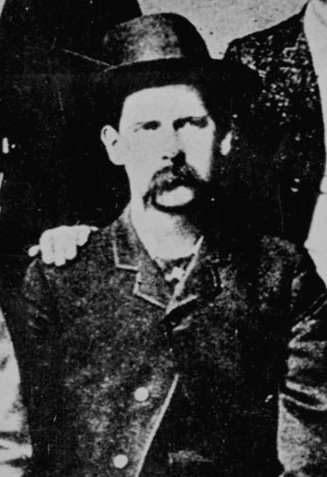
It was on this day, 1929, that the great American lawman, Wyatt Earp died at his home in Los Angeles, California. One might consider the movies detailing him to embellish his character. However, it is known that Earp was a fearless law enforcer, a shrewd gambler and of course, instrumental in The Gunfight At The OK Corral and in avenging the death and serious injury of his brothers afterwards. And it should be remembered that the first movies about him were made while he was still alive!

Born Wyatt Berry Stapp Earp in Monmouth, Illinois, in 1848, Earp and three brothers headed west for glory and adventure. While working as a buffalo hunter, Earp met Masterson and the eventual friends became peace officers in the area of Dodge City, Kansas. Earp developed a reputation, not as a famous gunfighter, but as one who was able to keep order without firing a gun. After serving as deputy marshal and deputy sheriff for many years, in 1879, Earp and his brothers left for Tombstone, close to the Mexican border. It was in this lawless territory that they became caught up in repeated clashes with the local criminal element, cowboys who stole cattle back and forth over the border and regularly raided stagecoaches.

On October 26, 1881, three of the Earp brothers and Hollidayfought four men in the famed shootout at (although in reality, it was only nearby) the OK Corral. The other four men, Ike and Billy Clanton and Tom and Frank McLaury, were cowboys whose general lawlessness had grown into a full-fledged feud with the Earps. The fight left the McLaurys and Billy Clanton dead; Wyatt Earp was unhurt, though his brothers and Holliday all suffered gunshot wounds. At this juncture, Hollywood has immortalized Earp. However, shortly thereafter, he lost two brothers to gunfire in revenge, and he began a mission of retribution with Holliday that led to the shooting deaths of the suspects. He then rode out of Arizona, beyond the jurisdiction of the then-local law. Earp lived out his remaining days in California with his common-law wife, Josephine.